PScoat façade system: layer build-up, sequence and substrate
Jump through this article
According to the supplier’s documents, the PSC 250 T façade system consists of three layers that are applied in a fixed sequence: primer, functional layer, finish. Anyone who specifies, purchases or applies the system must keep two things apart: which layer has which task, and which layer a thickness figure refers to. The following information comes from the system manual PSC-FAS-001 (version 1.0, June 2026 edition) and from the “Wirkprinzip” (principle of operation) page on pscoat.uk. It is information provided by the supplier.
Three layers, three tasks
| Layer | Product | Task according to the manual | Layer thickness | Consumption (guide value) |
|---|---|---|---|---|
| Primer | PSC 250 T ECB BASIC B | Adhesion of the subsequent layers, resistance to corrosion and water condensation | approx. 0.1 mm | 100–200 ml/m² |
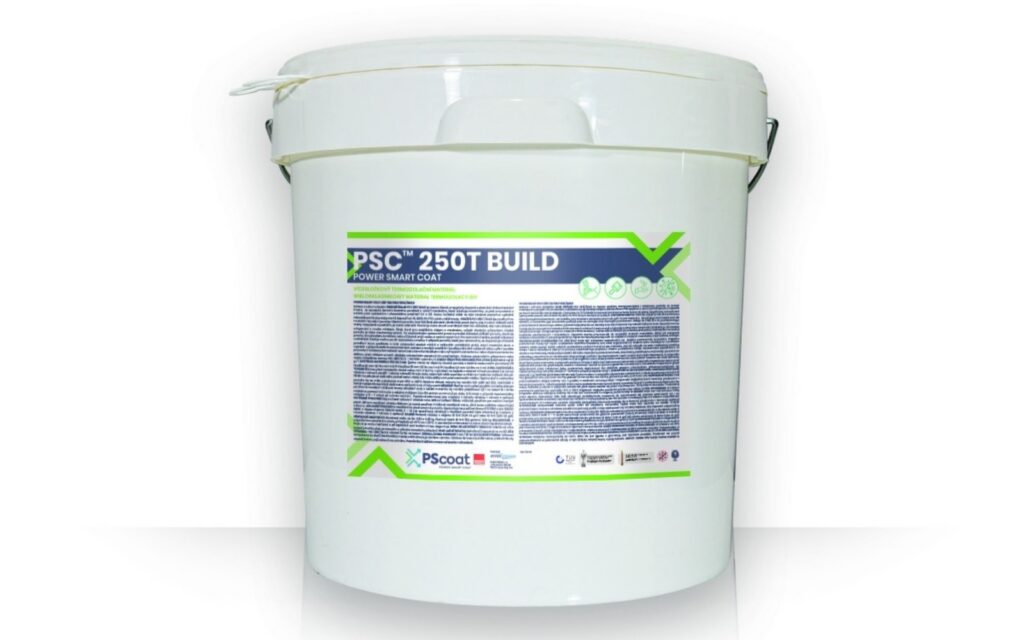
| Functional layer | PSC 250 T BUILD | thermally reflective functional layer, in two passes | 1.0 mm (2 × 0.5 mm) | approx. 0.9 l/m² |
| Finish | PSC 250 T ECO OUTSIDE | weather-resistant, decorative top layer | 0.1–0.2 mm | 0.18–0.30 l/m² |
| Complete system | – | Sum of the three layers | approx. 1.2 mm | approx. 1.2–1.4 l/m² |
The consumption figures apply to a smooth substrate and without allowance for waste, overspray and junctions. Texture, absorbency and method of application change them considerably; consumption becomes binding only on a sample area. By calculation, 100 m² of façade at 0.9 l/m² of functional layer requires around 90 l, that is about five 18-litre containers, in each case without allowance. The figure “1 mm” in the technical data sheet refers to the functional layer; the complete system is around 1.2 mm. Binding are the thickness and consumption given in the technical information sheet for the batch delivered. According to the product page, an interior wall receives its own coating (PScoat ECI Interior); this article describes only the façade system.
Sequence of application
- Check the substrate: load-bearing capacity, cleanliness, moisture.
- Primer ECB BASIC B, approx. 0.1 mm. Can be recoated after 2 to 3 hours, curing takes around 24 hours.
- Functional layer BUILD, first pass, 0.5 mm. The second pass follows after 4 to 8 hours.
- Functional layer BUILD, second pass, 0.5 mm.
- Finish ECO OUTSIDE, 0.1–0.2 mm. Then 24 hours of maturing.
Application is preferably by airless spraying. The equipment filter must be removed because the coating contains ceramic nanospheres; the spray pressure is limited to a maximum of 120 bar. Alternatively, brush or roller with a pile length of 8 to 14 mm are approved.
Air and substrate temperature must be between +5 and +30 °C, relative humidity below 80%. The fresh coating must be protected from rain and frost for at least six hours. According to the supplier, third-party coatings on the finished build-up are not approved because they change emissivity and vapour permeability.
Substrate requirements
- Dry, firm and load-bearing, free of loose parts, oil, grease, dust, mould, salt and loose old coatings.
- Substrate moisture below 4%, for concrete below 2.5%; measured with a suitable instrument, and where in doubt wait until the substrate is ready for coating.
- Load-bearing capacity by visual and wipe test for sanding of the surface, scratch and tap test for hollow areas and, where in doubt, by pull-off or cross-cut testing on the primer.
- Not suitable: PE, HDPE, PP, PTFE and other plastics.
These are the supplier’s test steps. They replace neither the contractual duties to inspect nor a substrate inspection under the VOB rules; there is a separate article on this: Checking the substrate under VOB and BFS.
What remains with the contractor carrying out the work
The contractor carrying out the work remains responsible for the substrate inspection, the risk assessment and a project-specific sample area before execution. The sample area also shows the actual consumption: according to the system data, an 18-litre container of functional layer covers around 20 m², a calculated value that may differ on the project.
Planning also includes storage: in the unopened original container, the shelf life is 24 months, frost-free at +5 to +30 °C and protected from direct sunlight.
Sources
- Systemhandbuch PSC-FAS-001 Nanofassadendämmung (system manual, nano façade insulation) (Fassade) – version 1.0, June 2026 edition
- Wirkprinzip: Strahlung statt Dämmstoffdicke (principle of operation: radiation instead of insulation thickness; system data PSC 250 T) – accessed 30 October 2026
- PowerSmartCoat: Produkt und Systemschichten (product and system layers) – accessed 30 October 2026